
Table of Contents
- Introduction
- What You’re Actually Fighting
- Step 1: Eliminate Shared Logins
- Step 2: Role-Based Permissions
- Step 3: Full Audit Trails
- Step 4: Automate Anomaly Alerts
- Step 5: Formalise Stock Transfers
- Step 6: Scheduled Stock Reconciliation
- Step 7: One Real-Time View
- Step 8: Track These Numbers Every Month
- The Bottom Line
- Frequently Asked Questions
- Want to Automate Loss Prevention?
How to Prevent Employee Theft and Stock Shrinkage in Multi-Branch Retail Stores
If you run more than one retail branch, you already know the uneasy feeling: one location’s numbers just don’t add up the way the others do. You can’t be there every day to watch what’s actually happening at the till. The sales reports look fine on the surface, but the stock room tells a different story.
To prevent retail employee theft, you need more than trust. You need a system that catches discrepancies within days, not months.
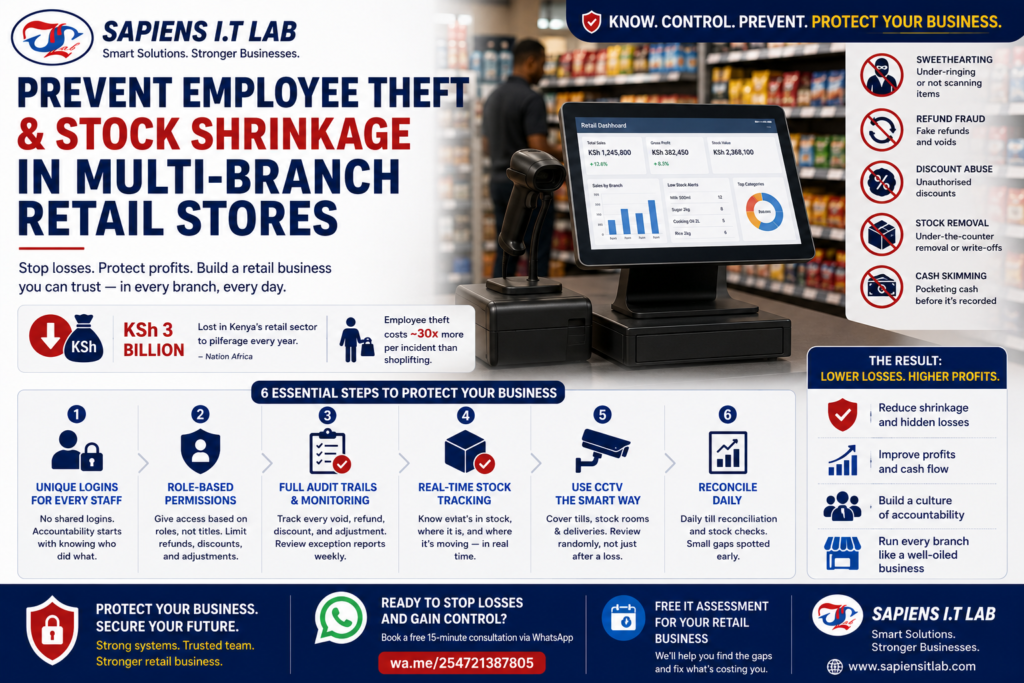
You’re not imagining it, and you’re not alone. Kenya’s formal retail sector loses an estimated Sh3 billion a year to pilferage. Industry data shows theft not damage, not accounting error accounts for the clear majority of that shrinkage.
Here’s the detail most owners don’t expect: employee theft is typically far more costly per incident than shoplifting. A local retail theft study found that employees who steal average roughly Ksh 15,800 per incident. That’s nearly 30 times more than the average shoplifter’s Ksh 550 per case.
Academic research on Kenyan supermarket staff further points to a consistent root cause: theft thrives wherever monitoring systems are weak and the opportunity to steal is easy to find.
The good news is that this is a solvable, system-level problem. It’s not fixed by trusting people harder or hiring more floor supervisors. Instead, it’s fixed the same way banks and telcos fixed internal fraud: individual accountability, visible audit trails, and reconciliation processes that catch a discrepancy within days, not at year-end stocktake. Here’s exactly how to build that into a multi-branch retail operation.
First, Know What You’re Actually Fighting
Employee theft in retail rarely looks like someone stuffing stock into a bag. It’s usually far more subtle, and far more damaging over time. It hides inside legitimate-looking transactions:
Sweethearting – a cashier under-rings or doesn’t scan items for a friend or accomplice at checkout.
Refund and void fraud – processing a fake refund or voiding a completed sale, then pocketing the cash while the system shows the item as “returned” or “never sold.”
Discount abuse – applying an unauthorised discount code, then collecting the difference in cash from the customer.
Under-the-counter stock removal – items moved out through deliveries, waste bins, or informal “damaged goods” write-offs that were never actually damaged.
Cash skimming – pocketing cash before it’s ever recorded in the till, particularly common where shift handovers aren’t tightly reconciled.
Undocumented stock transfers – moving inventory between branches informally, without a logged transfer record, so it simply “disappears” from one branch’s count without a trace of where it went.
Every one of these tactics has one thing in common: they exploit a system that can’t tell you, with certainty, who did what, when, and from which till. That’s exactly what a well-configured POS and inventory system is built to close.
Step 1: Eliminate Shared Logins – Every Staff Member Gets Their Own
This is the single most common, and most fixable, security gap in Kenyan multi-branch retail: staff sharing one till login because it’s “faster.” The moment two or more people use the same credentials, accountability disappears entirely. You can no longer prove who processed a specific void, refund, or discount. This makes even a perfect audit trail useless.
Action: Every staff member, at every branch, gets an individual login. No exceptions. No “manager’s PIN” shared informally at shift handover.
Step 2: Set Role-Based Permissions, Not Blanket Access
Not every staff member needs the same level of access. A cashier should process a sale, but not authorise a large discount or refund without a supervisor’s approval. A branch manager should see that branch’s full data, but shouldn’t necessarily have chain-wide financial export access unless that’s genuinely part of their role.
Structure permissions around actual daily tasks, not job titles alone:
• Who can process a refund, and up to what value before it needs approval?
• Who can apply a discount, and what’s the maximum without a manager override?
• Who can adjust stock counts or mark items as damaged/written off?
• Who can view chain-wide reports versus their own branch only?
Set this centrally from head office so every branch runs the same baseline security policy. Only allow deliberate, documented exceptions for example, a higher refund limit for a senior branch manager.
Step 3: Turn On Full Audit Trails and Actually Review Them
Every void, refund, discount, price override, and stock adjustment should be logged automatically. The system should record who did it, when, from which till, and why (if a reason code was required). This is standard functionality in a modern POS system. The part most businesses miss is that nobody’s actually reviewing the logs.
Action: Set a standing weekly review of exception reports voids, refunds and discounts above a set threshold, and any adjustments made outside normal trading hours. Patterns worth investigating immediately include one till consistently generating more voids than others, or a spike in refunds right before a shift change.
Step 4: Automate Anomaly Alerts
Rather than manually scanning reports, configure automatic alerts for the patterns that most often signal theft:
• An unusual spike in voids or refunds at a specific till
• Discounts applied significantly above a branch’s normal average
• Transactions processed outside normal operating hours
• Repeated “damaged goods” write-offs for the same product or staff member
Catching these within days, rather than at the next full stocktake, is what actually stops small losses from compounding into a Ksh 15,800-plus incident.
Step 5: Formalise Every Stock Transfer Between Branches
In a multi-branch operation, stock moving informally between locations “just send two crates over, I’ll sort the paperwork later” is one of the easiest ways for inventory to disappear without a trace. Once it leaves branch A’s system record but never properly arrives in branch B’s, nobody can prove where it actually went.
Action: Require every inter-branch transfer to go through a logged transfer record before goods physically move – sender, receiver, items, quantities, and confirmation of receipt at the destination branch. No stock moves on a verbal agreement.
Step 6: Run Scheduled Stock Reconciliation – Not Just an Annual Stocktake
Waiting for an annual or even quarterly stocktake to catch shrinkage means months of undetected loss by the time you find it. Build reconciliation into a regular rhythm instead:
1. Weekly spot-checks on high-value or high-theft-risk product categories.
2. Monthly full counts per branch, physical stock compared against system stock.
3. Segregate duties – the staff member receiving deliveries should not be the same person conducting the reconciliation count.
4. Document every variance, however small, and track it by branch and by product category over time. A single missing item is noise. The same category showing a repeated shortfall at the same branch is a pattern.
Step 7: Get One Real-Time View Across All Branches
Managing several branches through separate spreadsheets, or by phoning each manager for a daily update, makes theft nearly invisible until it’s already significant. A centralised, cloud-based system gives head office live visibility of sales, stock levels, and staff activity across every branch from one dashboard without needing to physically be in every store at once.
This is also where CCTV footage becomes genuinely useful for investigation rather than just deterrence. Footage timestamped against the exact POS transaction log lets you confirm, rather than guess, what actually happened at a specific till at a specific time.
Step 8: Track These Numbers Every Month
Put these on your management review agenda for every branch, every month:
1. Shrinkage rate – variance between recorded and physical stock, as a percentage of stock value
2. Void and refund rate – per till and per staff member, compared against the branch and chain average
3. Discount rate – average discount given, flagged where it deviates significantly from policy
A branch or employee that consistently sits outside the normal range on any of these numbers deserves a closer look not necessarily an accusation, but a conversation and a review of that till’s activity log.
The Bottom Line
Employee theft in multi-branch retail isn’t stopped by trusting staff more or hoping a security guard at the door catches everything. Shoplifting is only a fraction of total shrinkage. The far more expensive losses usually come from inside the till.
Individual logins, role-based permissions, reviewed audit trails, formal stock transfers, and regular reconciliation together close the exact gaps that theft depends on. None of this requires treating your staff like suspects. It requires a system that can answer, with certainty, who did what and when, every single time.
Want to Automate Loss Prevention Across Every Branch?
Manually reviewing till reports, chasing stock transfers on WhatsApp, and reconciling spreadsheets branch by branch is exactly how shrinkage goes unnoticed for months. Sapiens IT Lab’s managed IT services team sets up multi-branch POS and inventory systems with individual logins, role-based permissions, automated audit trails, and real-time stock visibility across every location.
Want to automate your retail chain’s stock and loss-prevention controls? Book a 15-minute POS demo via WhatsApp or visit Sapiens IT Lab to request a free on-site IT assessment today – we’ll show you exactly where your branches are exposed.


