
Table of Contents
- Introduction
- Understanding the Two Faces of Pharmacy Leakage
- Step 1: Run an Honest Shrinkage Audit
- Step 2: Fix the Physical and Procedural Gaps First
- Step 3: Apply FEFO – Not Just FIFO
- Step 4: Move Expiry Monitoring to Automated Alerts
- Step 5: Turn This Into a Monthly Management Habit
- The Bottom Line
- Frequently Asked Questions
- Ready to Stop the Bleeding?
Stopping Pharmacy Leakage: How Modern HMIS Track Stock and Expiry in Real Time
If you run a hospital, clinic, or dispensary in Kenya, you’ve likely asked yourself the same question your peers are asking: where is our drug budget actually going?
You’re not imagining things. Over the past few years, Kenya has seen a steady stream of theft cases. A senior staff member at a top private hospital in Nairobi recently stole pharmaceuticals worth millions. He siphoned the drugs over two years before CCTV and a forensic audit caught him.
Counties including Nakuru, Kericho, Turkana, Murang’a, and Machakos have all reported drugs disappearing from public stores. Some ended up in private chemists next door. Auditor-General reports have flagged counties using disorganised physical ledgers. In those cases, no one could reconcile what was delivered against what was dispensed.
A quieter problem also affects almost every facility: stock expiring because nobody flagged it in time. These write-offs eat directly into your bottom line.
If your pharmacy still relies on manual bin cards, Excel sheets, or “someone will remember to check,” you are not managing your inventory. You are hoping it manages itself. And hope is not a control system.
The good news: this is one of the most fixable problems in hospital operations. It doesn’t require firing your whole team or overhauling your facility. It requires visibility – knowing, in real time, exactly what stock you have, where it is, who touched it, and when it expires. Here’s how to get there.
Understanding the Two Faces of Pharmacy Leakage
Before you can fix leakage, you need to name it correctly. The fix depends on the cause.
1. Theft and diversion (internal shrinkage) – Stock leaves your facility without a sale, prescription, or documented write-off. An insider may quietly move boxes through a back door. A staff member might under-record dispensed quantities. Alternatively, hospital stock can end up in a private chemist near the facility gate.
2. Expiry and wastage – Stock sits on your shelf, fully accounted for. However, it becomes worthless because nobody rotated it, forecasted demand, or acted on the expiry date. Hospital pharmacies typically write off a low single-digit percentage of their drug budget to expired stock. That sounds small until you multiply it against your total pharmaceutical spend.
Both problems share the same root cause: a lack of real-time, item-level visibility. If you can’t see it, you can’t stop it.
Step 1: Run an Honest Shrinkage Audit (Do This This Month)
You cannot fix what you haven’t measured. Before buying any tool, get a baseline.
• Pull your system stock report (or your last full stock take) for every item in the pharmacy store.
• Count everything physically – every shelf, every fridge, every box, batch by batch. Don’t sample. Count everything at least once a quarter.
• Calculate your shrinkage rate:
Shrinkage Rate (%) = (Recorded Stock Value − Physical Stock Value) ÷ Recorded Stock Value × 100
• Split the gap into three buckets: confirmed expiry write-offs, documented damage/returns, and unexplained variance. The third bucket signals theft and administrative error.
• Flag high-risk items separately – antibiotics, controlled substances, and injectables are the most targeted categories. They need tighter controls than paracetamol.
If your unexplained variance exceeds 1-2% of stock value, you have an active leakage problem, not a rounding error.
Step 2: Fix the Physical and Procedural Gaps First
Technology alone won’t stop theft if your physical controls are broken. Kenyan audit reports repeatedly point to the same issues: stock rooms with no access control, deliveries without proper documentation, and stock cards that don’t match dispensing records.
Before or alongside any system rollout, tighten these basics:
• No stock leaves the store without being received, recorded, and logged first. This single rule closes the biggest loophole: informal, undocumented drug movement.
• Restrict physical access to the pharmacy store. Only named, authorised staff with logged entry can enter.
• Separate duties – the receiving person should not reconcile stock at month-end.
• Place your store away from public access points. Stores near unmonitored back doors or public roads attract theft.
• Install CCTV at receiving bays, dispensing counters, and store entry points. Keep footage long enough to support investigations weeks later.
Step 3: Apply FEFO to Every Shelf
Kenya’s Pharmacy and Poisons Board (PPB) Good Pharmacy Practice guidelines explicitly require First-Expiry-First-Out (FEFO), not first-in-first-out. This means the item nearest expiry always goes to the front and gets dispensed first.
The PPB guidelines add another rule: refuse deliveries of short-dated stock. A facility should not accept an item with less than a third of its total shelf life remaining. For a three-year shelf life, don’t accept stock with under twelve months left. Build this into your procurement checklist and hold suppliers accountable.
Manually enforcing FEFO across hundreds of SKUs and multiple batches breaks most paper-based systems. Nobody can check every batch’s expiry before each dispense. This is exactly the gap that real-time HMIS pharmacy modules close.
Step 4: Automate Expiry Monitoring
Under PPB guidelines, facilities must maintain an expiry monitoring chart for short-expiry commodities. Doing this on paper works for a 50-item dispensary. However, it collapses completely for a multi-department hospital formulary.
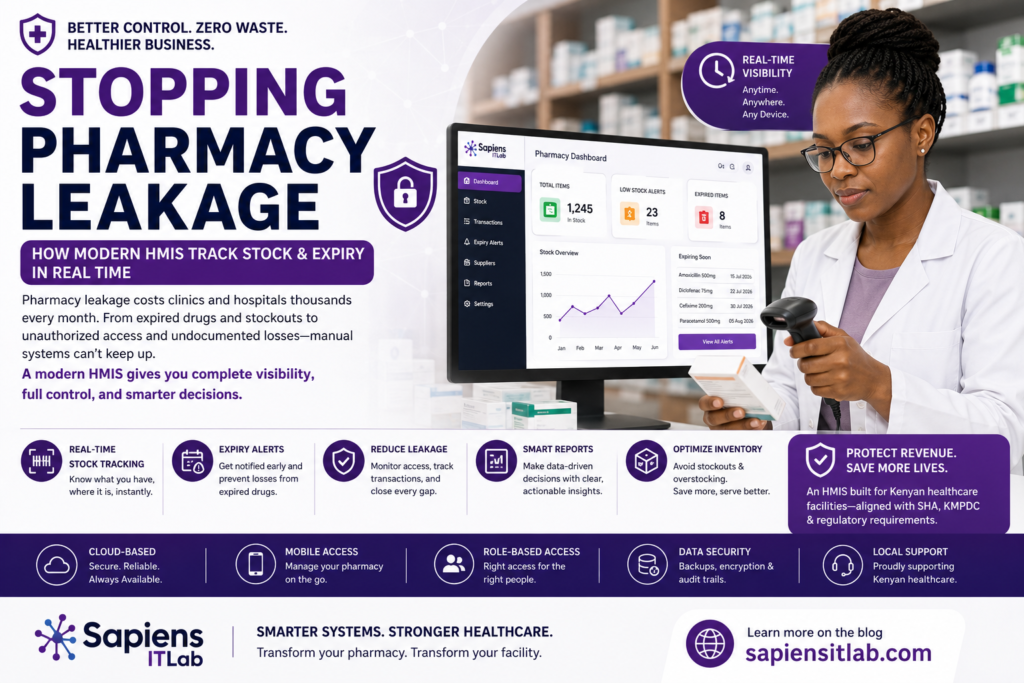
A modern HMIS pharmacy module should give you these features without manual work:
• Batch and expiry tracking at receiving every unit carries its batch number and expiry date automatically.
• Automated alerts at 90, 60, and 30 days before expiry routed to the pharmacist and store manager. This gives you time to redistribute, discount, return, or clinically prioritise stock.
• A live dashboard showing stock value, near-expiry items, and slow-moving stock across every department not a report you must request.
• A full audit trail – who received, moved, and dispensed the stock. When a physical count doesn’t match the system, you can trace the discrepancy to an exact transaction and person.
Step 5: Monthly Management Habit
Systems don’t fix leakage on their own, consistent review does. Put these three numbers on your management meeting agenda every month:
1. Shrinkage rate (unexplained variance as % of stock value)
2. Expiry write-off rate (expired stock value as % of total drug spend)
3. Stock turnover ratio (fast-movers vs. slow-movers)
A facility that reviews these numbers monthly catches problems in weeks. A facility that only discovers them at year-end audit catches them after the money is already gone.
The Bottom Line
Drug theft and expiry waste in Kenyan facilities are not separate problems – they’re two symptoms of the same disease: stock you can’t see in real time. Fix the visibility, and both problems shrink together. Facilities making headlines for six- and seven-figure losses share the same root cause: manual, disconnected stock records that nobody could reconcile until it was too late.
You don’t need to wait for a CCTV scandal or an Auditor-General report to fix this. You can close these gaps starting this month.
Ready to Stop the Bleeding in Your Pharmacy Store?
Every month you run on manual stock cards or a generic POS is another month of unexplained variance you can’t account for. Sapiens IT Lab builds HMIS platforms with real-time, batch-level pharmacy stock and expiry tracking designed for Kenyan facilities and PPB compliance.
Want to automate your clinic’s pharmacy stock, expiry alerts, and insurance billing in one system? Book a free 15-minute HMIS demo via WhatsApp or request a free on-site IT assessment – our team will review your current pharmacy workflow and show you exactly where the leaks are, at no cost.
Chat with Us on WhatsAppFrequently Asked Questions
How much money do Kenyan hospitals typically lose to pharmacy leakage?
It varies by facility size and controls in place. However, internationally, pharmacy shrinkage commonly runs between 1-3% of inventory value. Expired-stock write-offs alone can consume a low single-digit percentage of a facility’s annual drug budget. For a mid-sized Kenyan hospital, that can easily translate into millions of shillings a year – money that should be reinvested in patient care.
What is FEFO and why does the Pharmacy and Poisons Board require it?
FEFO (First-Expiry-First-Out) means dispensing the stock closest to its expiry date first, regardless of when it was delivered. The PPB mandates it in its Good Pharmacy Practice guidelines specifically to reduce pharmaceutical waste and ensure patients receive safe, effective medication.
Can a small clinic afford real-time stock tracking?
Yes. Modern cloud-based HMIS pharmacy modules are built to scale a single-branch dispensary can run the same batch-tracking and expiry-alert features as a multi-branch hospital. The cost is far lower than the value of even one prevented theft or expiry write-off incident.


